
Table of Contents
High-pressure water jet cutting machines manufacturers offer the ultimate solution for high-precision, heat-free industrial fabrication. This 2026 guide provides factory-direct price lists, detailed pump specifications (40k vs 90k PSI), and a comprehensive USA vs. Global brand comparison. Don't finalize your procurement until you review our operational cost breakdown—save up to 20% on consumables and machine downtime by choosing the right system.
What Are High-Pressure Water Jet Cutting Machines?
Understanding Cold-Cutting Technology
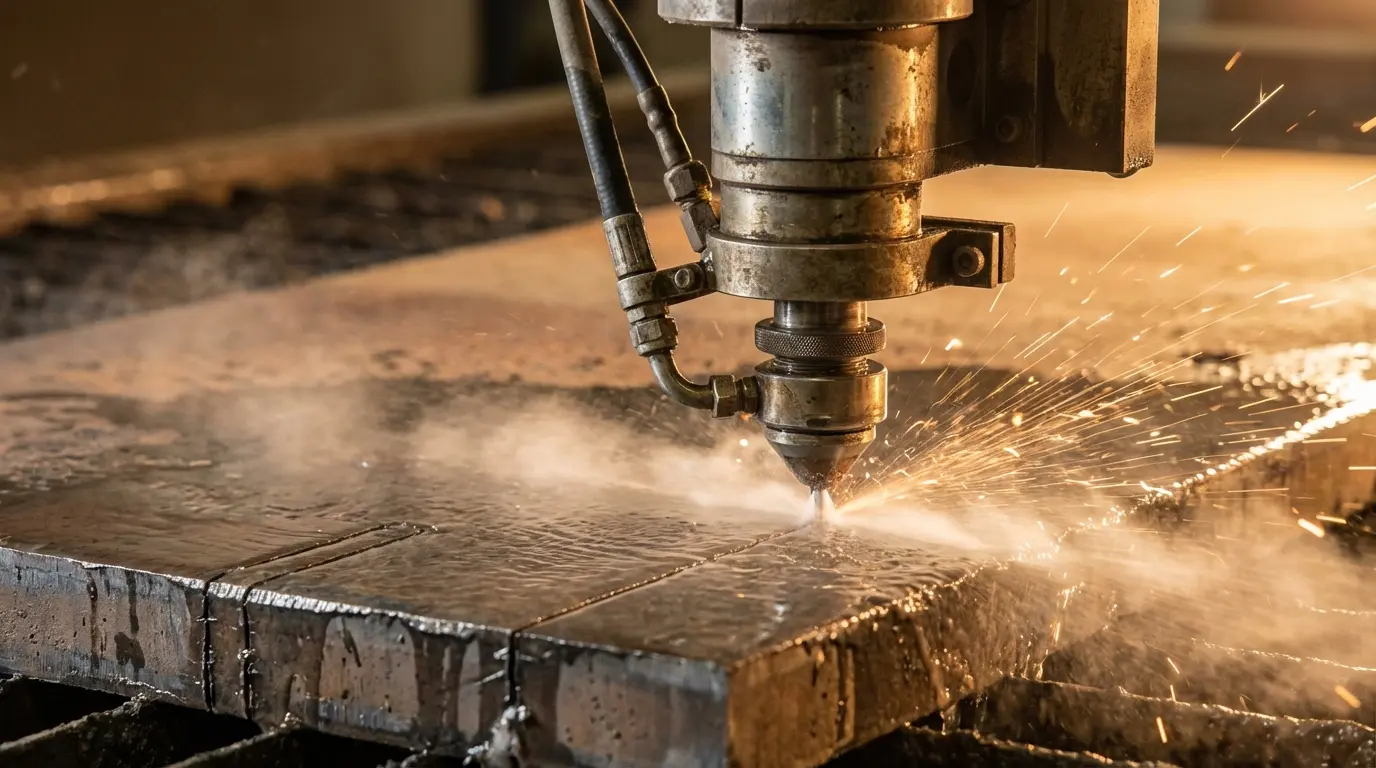
High-pressure waterjet cutting is an advanced cold-cutting technology that uses pressurized water streams to slice through diverse materials. Because the process avoids thermal friction and heat transfer, it completely eliminates the Heat-Affected Zone (HAZ). For high-pressure water jet cutting machines manufacturers, this is a critical advantage: it prevents material deformation, structural metallurgical alterations, and edge discoloration during fabrication.
The 4 Core Components of a Waterjet System
Industrial processing requires precise coordination among several mechanical components to generate extreme cutting forces. Manufacturers build these systems around four critical elements:
1. Intensifier Pump: Serving as the system's core, it uses a hydraulic piston with a surface area 20 times larger than the water piston. This layout multiplies 2,750 PSI of oil pressure into 40,000 to 90,000 PSI (up to 600 MPa) of water pressure, generating a Mach 3 velocity stream.
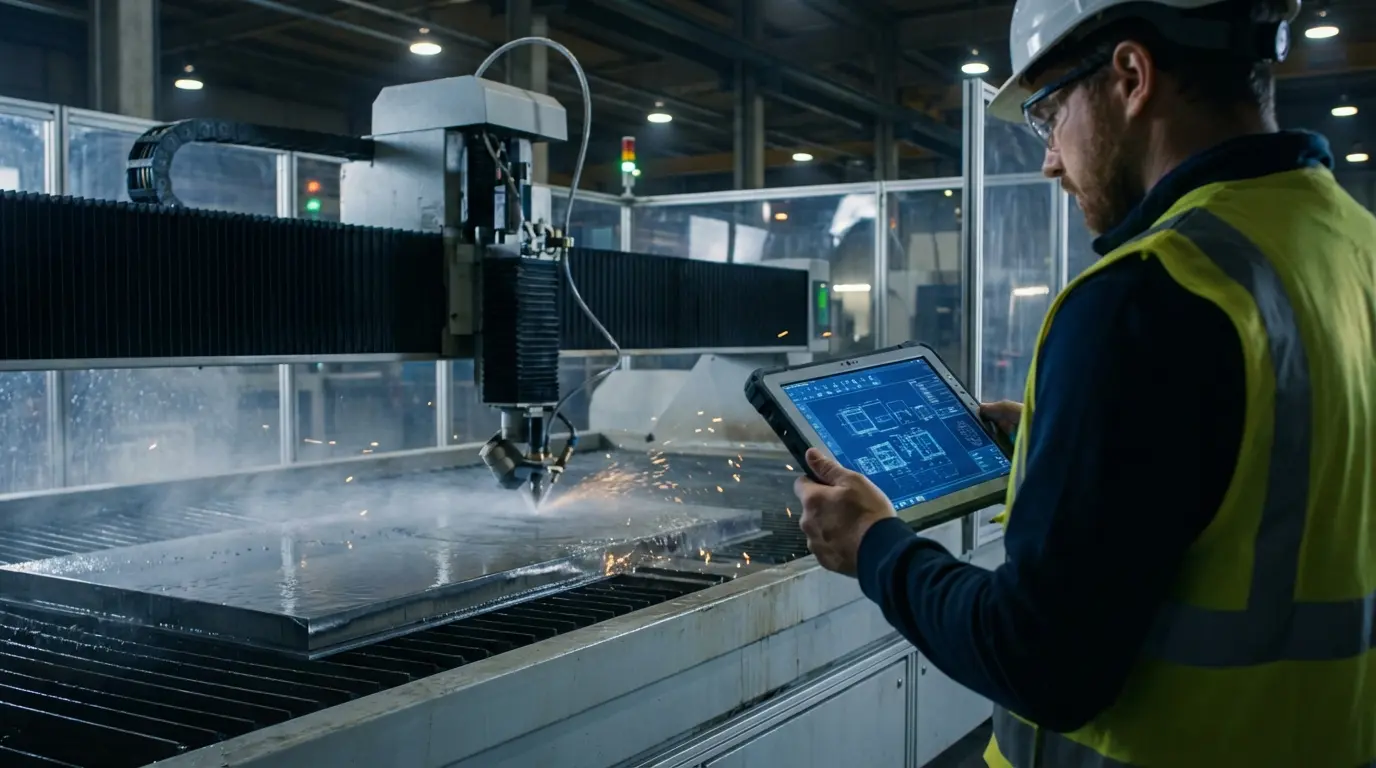
2. Abrasive Cutting Head: Features an internal mixing chamber where water combines with abrasive media. The pressurized stream then forces its way through an ultra-hard ruby or diamond orifice measuring exactly 0.010 to 0.015 inches in diameter.
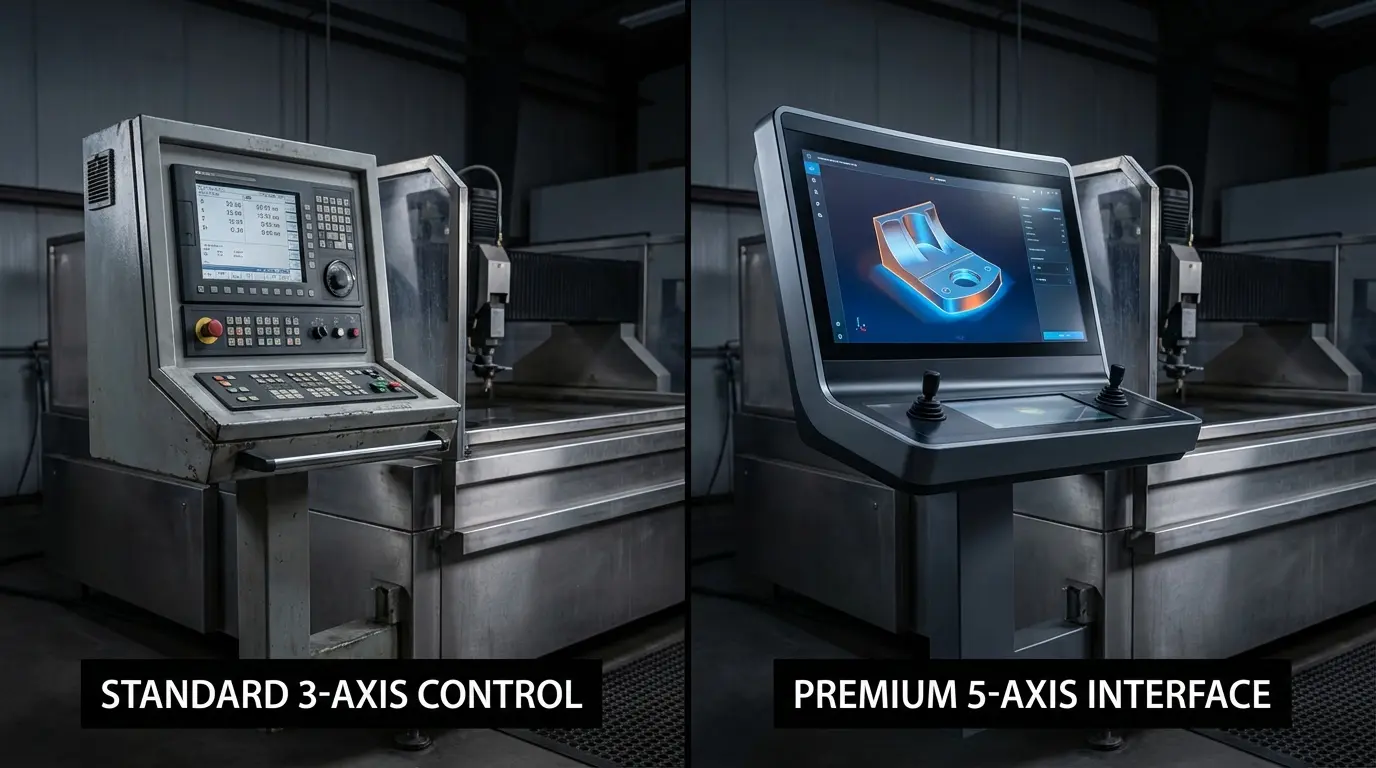
3. CNC Controller: The digital command center. Ranging from standard 3-axis controllers to advanced 5-axis platforms, this unit maintains tight tolerances and manages complex geometric toolpaths.
4. Catcher Tank: A heavy-duty water and steel bed positioned directly beneath the CNC platform. It safely dissipates the kinetic energy of the Mach 3 stream while capturing spent abrasive garnet and material scrap.
Abrasive vs. Pure Waterjet: Which Machine Is Best for Cutting?
Pure Waterjet Dynamics
Pure waterjet systems operate at standard pressures of 200–300 MPa (roughly 30,000 to 40,000 PSI) using only the kinetic energy of the water stream. This method excels when processing soft materials like rubber, industrial foam, textiles, and paper. By omitting abrasive particles, pure waterjets produce a micro-thin kerf width (often under 0.5mm), maximizing material yield for soft goods manufacturers.
Abrasive Waterjet Capabilities
For heavy-duty applications, the best industrial water jet cutting machines manufacturers integrate abrasive feed systems. These units operate at much higher pressures of 380–600 MPa (55,000 to 87,000+ PSI). By introducing 80-mesh garnet sand or carborundum into the high-pressure water stream inside the cutting head, the jet transforms into a highly erosive tool capable of slicing through hard, brittle materials. An abrasive waterjet can cleanly cut 2-inch thick mild steel at 1 to 3 inches per minute, depending on the required edge finish.
| Feature | Pure Waterjet | Abrasive Waterjet | Typical Applications |
|---|---|---|---|
| Operating Pressure | 30,000 – 60,000 PSI | 55,000 – 90,000 PSI | N/A |
| Cutting Mechanism | Pure kinetic water energy | Water mixed with 80-mesh garnet | N/A |
| Kerf Width | 0.5mm | 1.0mm – 1.5mm | N/A |
| Primary Materials | Rubber, foam, paper, cloth | Steel, titanium, stone, glass, ceramics | Gaskets, packaging, custom mosaics, aerospace parts |
What Are the Key Specifications for Industrial Waterjet Systems?
Pressure and Pump Dynamics
Selecting the correct technical parameters dictates a facility's production capacity. Pump pressure serves as the first crucial metric. Standard commercial configurations use 60,000 PSI systems, while hyper-pressure setups reach 90,000 PSI (approx. 600 MPa). Drive technology is equally important. A 50HP Direct Drive pump delivers over 90% energy conversion efficiency, making it highly effective for continuous, large-scale manufacturing. Conversely, a 100HP Intensifier pump provides the sheer force needed to reach and maintain 90,000 PSI, making it ideal for piercing ultra-thick or dense super-alloys.
CNC Precision and Format Capabilities
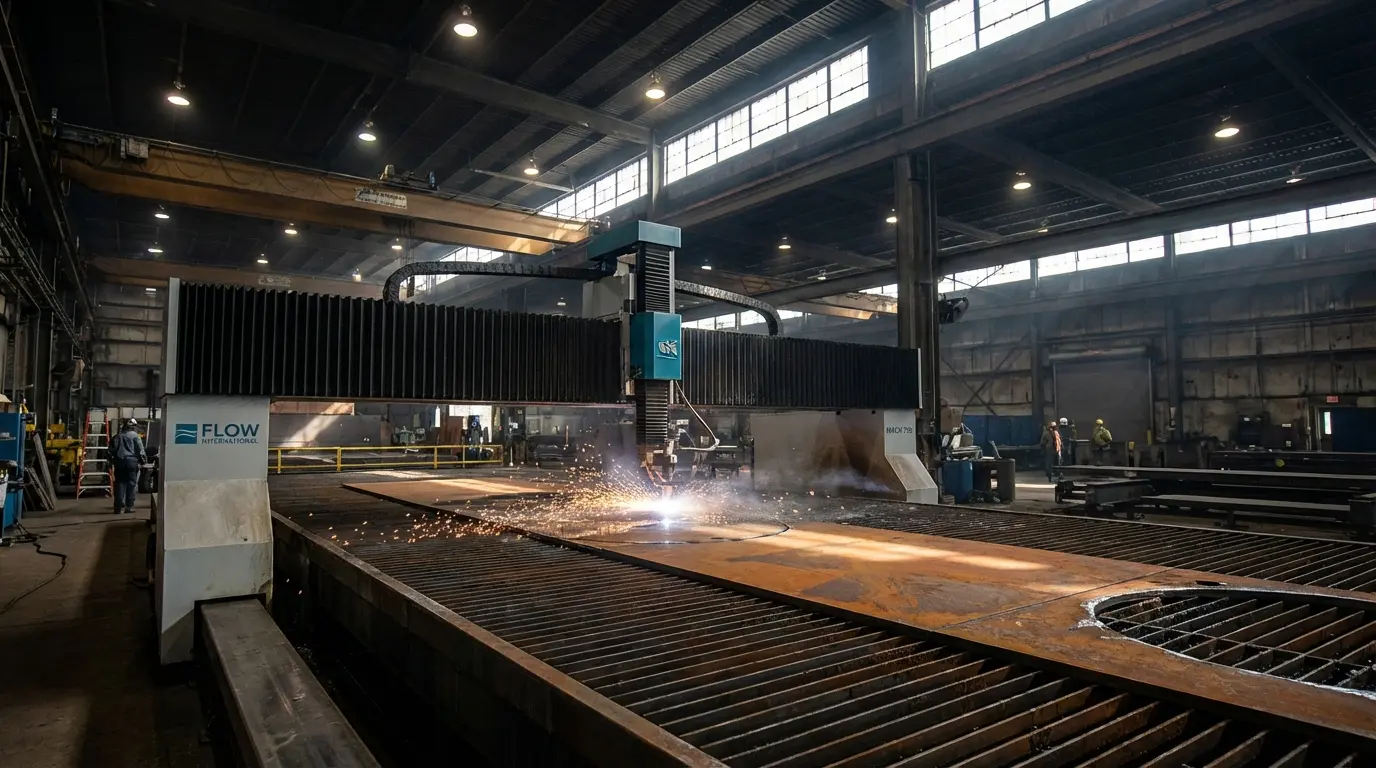
When reviewing 5-axis high pressure water jet cutter technical specifications, the cutting envelope size and positioning accuracy are fundamental. Entry-level machines provide a compact 4×4 ft envelope suitable for job shops, whereas heavy-duty fabrication requires massive 13×13 ft or larger formats to handle industrial sheet stock. Premium machines achieve positioning tolerances between ±0.001 and ±0.003 inches (±0.05mm to ±0.02mm), ensuring finished components meet rigorous aerospace and automotive standards.
| Parameter | Standard Specs | Premium Specs | Impact on Production |
|---|---|---|---|
| Pump Pressure | 60,000 PSI (400 MPa) | 90,000 PSI (600 MPa) | Premium speeds up cutting by 30-50% on thick materials. |
| Drive Technology | 50HP Direct Drive | 100HP Linear Intensifier | Direct drives offer energy efficiency; Intensifiers allow hyper-pressure output. |
| Cutting Envelope | 4×4 ft to 5×10 ft | 13×13 ft and larger | Determines the maximum sheet stock size processed per cycle. |
| Positioning Accuracy | ±0.003 inches (±0.05mm) | ±0.001 inches (±0.02mm) | Premium accuracy eliminates secondary machining on critical parts. |
Which Industries Rely on Ultra-High Pressure Waterjet Systems?
High-Precision Aerospace and Automotive Fabrication
In 2026, ultra high pressure waterjet system suppliers remain heavily engaged with the aerospace sector. Aircraft component manufacturing demands absolute structural integrity. Waterjets can cut through materials up to 10-12 inches thick without altering the metallurgical properties of the core substrate. This is invaluable for processing fuselage skins and engine components where standard thermal methods would induce warping. In the automotive industry, New Energy Vehicle (NEV) manufacturers rely on waterjets for near-net shaping, a process that drastically reduces in-house prototyping and fabrication timelines.
Advanced Stone and Architectural Tile
Beyond metals, the architectural fabrication industry depends on multi-axis waterjet technology to cut brittle composites, natural stone, and heavy glass. While standard bridge saws often struggle with complex interior shapes, CNC waterjets execute perfectly smooth radii without applying mechanical stress to the slab.
- Aerospace | Titanium alloys, stainless steel, carbon composites | *Key Benefit:* Zero thermal distortion and stable material performance.
- Stone & Tile | 3cm thick granite, marble slabs, heavy ceramics | *Key Benefit:* Exact miter cuts for sink cutouts and mosaics without edge micro-fractures.
- Automotive Fabrication | High-end NEV body components, aluminum panels | *Key Benefit:* Near-net shaping slashes in-house production time by up to 40%.
2026 High-Pressure Waterjet Manufacturers Comparison: USA vs Global
Evaluating Domestic USA Brands
When assessing the largest waterjet manufacturers in the USA vs Global competitors, distinct market positions emerge. Leading USA manufacturers like OMAX (known for highly efficient direct-drive pumps and proprietary software), Flow (recognized for its Mach 500 series and dual-bridge technology), and WARDJet (experts in customizable Z-Series tables) dominate the premium domestic tier. These systems feature robust local service networks and offer rapid 4-8 week lead times. However, they require significant capital: basic models start at $100,000, while advanced 5-axis setups easily exceed $500,000.
The Advantage of Global Asian Manufacturers
Rapid technological advancements have enabled Asian manufacturers to produce highly stable, commercially viable 3-axis, 4-axis, and 5-axis cutting systems capable of reaching 550 MPa. These global B2B platforms generally require standard trade terms, such as a 1-unit MOQ and a 30/70 T/T payment structure. Although sea-freight logistics extend lead times to 12-16 weeks, the capital savings are substantial. Robust industrial equipment from these imported suppliers typically starts in the $40,000 to $50,000 range.
| Brand Origin | Starting Price ($) | Lead Time | Key Strength | Target Buyer |
|---|---|---|---|---|
| USA Manufacturers (Flow, OMAX, WARDJet) | $100,000 – $150,000+ | 4-8 weeks | Advanced proprietary software, local rapid support network | High-volume aerospace, local enterprise contractors |
| Global/Asian Manufacturers | $40,000 – $50,000 | 12-16 weeks | Exceptional capital cost savings, stable multi-axis hardware | Cost-conscious fabricators, heavy industry importers |
Complete Machine Cost & Maintenance Breakdown: What to Expect?
Capital Expenditure and Operating Costs
Breaking down waterjet cutting machine cost and maintenance requires separating initial CapEx from ongoing OpEx. The machine's base price ranges from $40,000 for imported base models to $150,000+ for domestic high-end 5-axis units. Once operational, running costs average between $12 and $30 per hour of continuous cutting. Power and water consumption make up a small fraction of this, generally costing $3 to $5 per hour depending on local utility rates.
Wear Parts and Consumables Lifecycle
The majority of operational expenses—roughly 50% to 60% of total running costs—stem from the abrasive feed. Typical machines consume 1 to 2 lbs of garnet per minute, with industrial-grade garnet priced at $0.20 to $0.40 per lb. Operators must also factor in high-pressure wear parts. Mixing tubes degrade over time and require routine replacement, while internal high-pressure seals endure intense mechanical stress and must be swapped out according to strict maintenance schedules.
| Item | Estimated Cost | Replacement Frequency | Cost Per Hour |
|---|---|---|---|
| Machine Base Price | $40,000 – $150,000+ | N/A (One-time CapEx) | Amortized based on usage |
| Garnet Abrasive | $0.20 – $0.40 / lb | Burns 1 – 2 lbs per minute | $12.00 – $48.00 / hour |
| Mixing Tube | $100 – $200 | Every 80 hours | ~$1.25 – $2.50 / hour |
| High-Pressure Seals | $500 – $2,300 | Every 500 – 2,000 hours | ~$1.00 – $1.15 / hour |
| Power & Water Consumption | Local Utility Dependent | Continuous | ~$3.00 – $5.00 / hour |
Real-World ROI: Case Studies in Modern Fabrication Factories
Aerospace Manufacturing Transformation
Determining how to choose a waterjet cutting machine factory partner often comes down to proven production capabilities. In the aerospace sector, one supplier successfully transitioned from standard plasma and laser setups to a 90,000 PSI 5-axis abrasive waterjet, yielding immediate returns. Because the abrasive waterjet functions as a cold-cutting tool on 2-inch thick titanium and Inconel, it entirely bypassed heat-affected edge damage. This eliminated the need for secondary edge-finishing, achieving a 99%+ alignment between the CAD simulation and the final processed part.
Custom Stone Fabrication Upgrades
In the architectural sector, material waste heavily impacts profit margins. A custom marble fabricator deployed an automated 5-axis stone bridge sawjet system to process complex kitchen and mosaic cuts. Integrating CNC precision prevented the fragile stone blowouts often caused by manual bridge saws.
- Factory Type: Aerospace Parts Supplier
- Action Taken: Switched from laser cutting to a 90,000 PSI 5-axis abrasive waterjet to cut 2-inch thick titanium super-alloys.
- Quantified Result: Completely eliminated secondary edge-finishing, saving 15 labor hours per production batch while reducing material scrap.
- Factory Type: Custom Marble Fabricator
- Action Taken: Deployed an intelligent 5-axis stone sawjet to process heavy stone slabs.
- Quantified Result: Increased stone mosaic production efficiency by +45% and reduced raw material waste from 12% down to just 4%.
How to Buy from High-Pressure Waterjet Manufacturers (Import Guide)
Sourcing and Validation
Procuring heavy capital equipment across borders requires rigorous due diligence. International B2B buyers must navigate both technical validation and logistical planning to ensure a seamless import process. For high-pressure water jet cutting machines manufacturers, the MOQ is universally set at 1 unit, reflecting the heavy industrial nature of the asset.
Logistics and Compliance
Follow this strategic procurement process when executing international orders:
- Step 1: Verify Customs Classification. Ensure your commercial invoice and documentation list the correct global HS Code (8456.90 for waterjet cutting machines, with parts falling under 8466.93) to accurately calculate import duties.
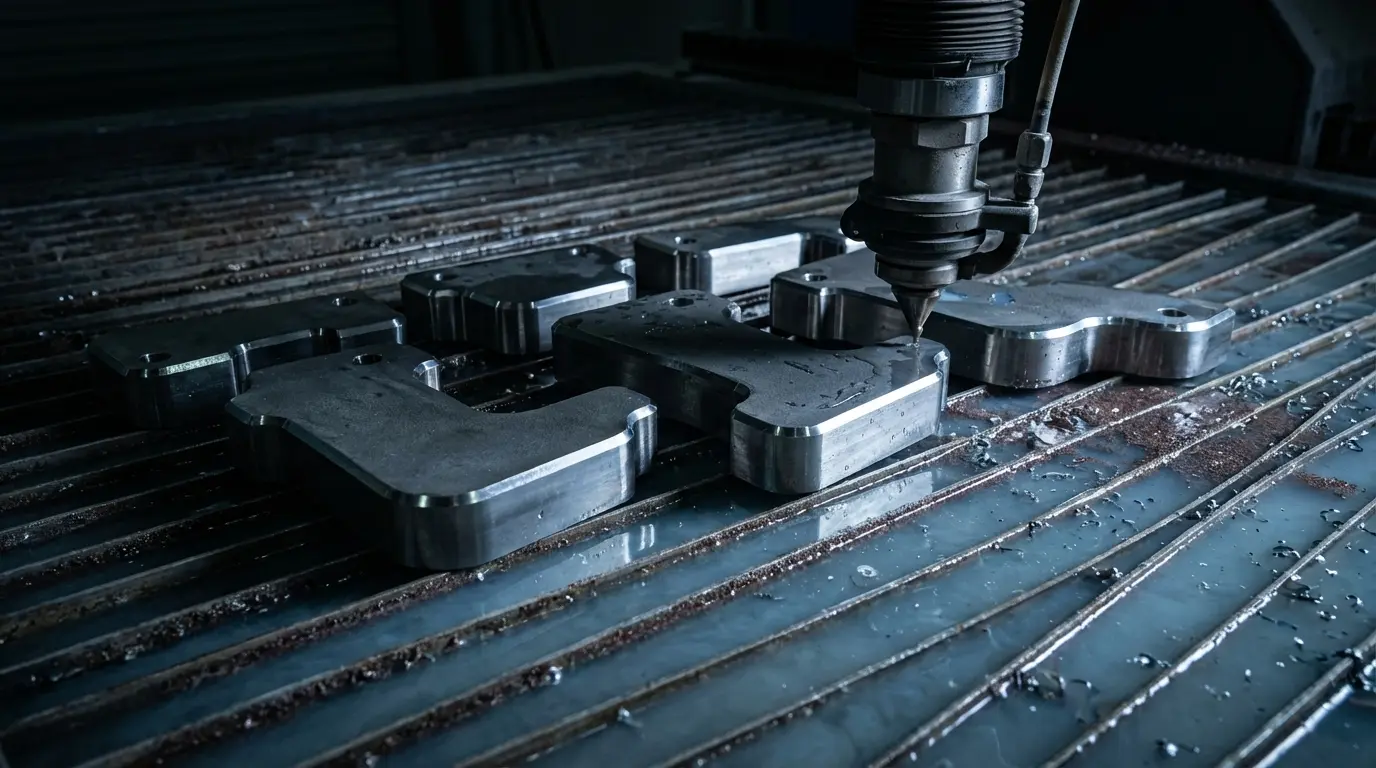
- Step 2: Request a Custom Test Cut. Never buy blind. Demand the manufacturer process a specific material sample (e.g., identical 0.5-inch aluminum or titanium) to evaluate true edge quality, cutting speed, and kerf alignment before placing a deposit.
- Step 3: Confirm Certification and Warranties. Mandate that the imported machinery holds authentic CE (for Europe) or UL (for USA) electrical safety certifications. Additionally, verify the scope of the standard 1-2 year warranty and the availability of spare parts.
- Step 4: Structure Payment Terms. Negotiate standard international B2B trade terms. This typically involves a 30% advance T/T deposit to initiate manufacturing, followed by a 70% balance payment after inspection but prior to final shipment.
- Step 5: Arrange Freight Logistics. Consult with a freight forwarder to book appropriate sea freight. Depending on the cutting envelope size, shipping will require a 20ft or 40ft FCL (Full Container Load) to safely secure the equipment and catcher tank.
Frequently Asked Questions (FAQ)
What is the highest pressure water jet cutter available from manufacturers?
The absolute commercial maximum currently available operates at 600 MPa (approximately 87,000 to 90,000 PSI). These hyper-pressure systems use robust intensifier pumps to pierce exceptionally dense super-alloys. Meanwhile, standard industrial high-pressure units typically run at 420 MPa (approximately 60,000 PSI).
How much do high-pressure water jet cutting machines manufacturers charge for a Wazer vs industrial unit?
A Wazer desktop prosumer unit costs under $15,000 and is designed for hobbyists or light prototyping. In contrast, doing a highest pressure water jet cutter price comparison shows that genuine industrial USA machines (such as Flow or OMAX models) start at $100,000 and scale upward for large-format, continuous production environments.
What is the minimum order quantity (MOQ) when importing commercial high-pressure waterjets?
Because waterjet systems are heavy, capital-intensive manufacturing assets, the standard MOQ for importing commercial units from global suppliers is exactly 1 Unit.
Which high-pressure waterjet machine model is best for cutting 2-inch thick solid steel?
An abrasive waterjet cutter equipped with an ultra-high-pressure intensifier pump capable of 380-600 MPa (55,000–87,000 PSI) is optimal. It must feature an abrasive cutting head using an 80-mesh garnet feed to effectively erode dense 2-inch solid steel.
How do I calculate the hourly maintenance cost for high-pressure water jet cutting machines?
Total operating costs run between $12 and $30 per hour. To calculate your specific rate, combine local power and water consumption (~$3-$5/hour), the cost of consumable garnet sand (which makes up 50-60% of total costs, typically $10-$15/hour), and the amortized cost of wear parts like mixing tubes and high-pressure seals.
Conclusion
Investing in high-pressure waterjet technology fundamentally upgrades a facility's fabrication capabilities. By eliminating heat-affected zones, drastically reducing secondary edge-finishing times, and enabling the precise processing of materials ranging from 3cm thick granite to 2-inch aerospace titanium, waterjets deliver undeniable ROI. When mapping out your capital expenditure, weighing domestic options against high-performance global manufacturers allows for strategic budget optimization. Your final decision should hinge on the required cutting envelope size, positioning accuracy, pump drive technology, and the long-term cost of abrasive consumables.
If you are evaluating high-pressure water jet cutting machines manufacturers for your next facility upgrade, contact MAIS CNC today. Our engineering team provides factory-direct pricing on industrial-grade multi-axis waterjets, bridge saws, and precision stone cutting equipment. Request a customized consultation and test cut to see exactly how MAIS CNC machinery can optimize your specific material processing workflow, boost production efficiency, and significantly lower your operational costs. Let us help you select the precise system built to handle your toughest manufacturing demands.